

WTF is a Creative Technologist? with Tina Tarighian
Marrying art and work, getting creative at Google, and the long road it took to arrive there


There’s a type of person every major company is currently desperate to hire, and they look a lot like Tina Tarighian. As a senior creative technologist at Google’s Creative Lab in NYC, she’s exploring the frontier of AI and emerging technology. Previously, she sat for residencies at Pianos and the New Museum, designed ever-evolving visuals for bands like FCUKERS, and hosted shows at NYFW. Tarighian has carved out a career in a profession most people have never heard of — Creative Technology — but by virtue of the organizations she has collaborated with and the products she’s built, you’ll know the job, and the name, soon enough.
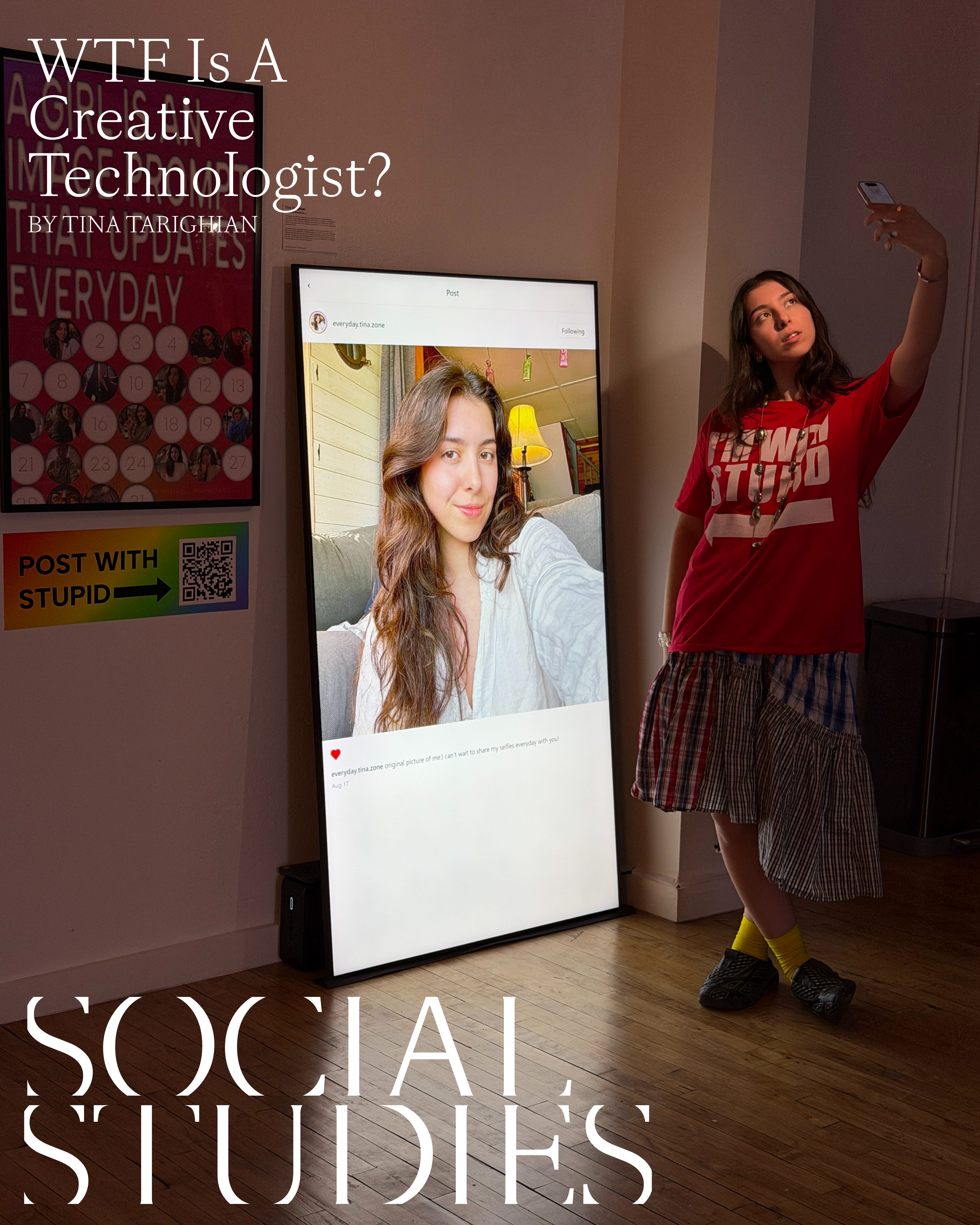
This is Social Studies. Where friends from the 3rd Space ecosystem contribute to what we hope will grow into an archive of the times. We believe written media is a two way portal to the soul, for both the reader and the writer. Expect deep convictions, personal manifestos, industry critiques, and to learn something you otherwise wouldn’t from someone we think you should hear from.
Here’s Tina Tarighian
When people ask me what I do for work, I always let out a little laugh. Not because it’s funny, but because what I say next always raises more questions than it answers. So, let me just skip to the part where you ask: “WTF is a creative technologist?”
If the best post-grad advice is to get your feet wet, I was standing in water up to my neck and smiling.


The title “creative technologist” has been around long enough to be enshrined by FAANG1 companies and well established agencies2 alike. And still, the title remains slippery enough that two people who share it might have completely different skills and workplace responsibilities.
On one end of the spectrum, you’ve got the “traditional” marketing world version from the dot-com boom. Everyone with something to sell suddenly needed a storefront on the internet, and they needed engineers to build it. To forgo the engineering salary, they invented a new title, slapped it under the marketing umbrella, and started recruiting from the growing pool of mystics who could talk to people and computers with the same suavity. Even within that cohort there’s considerable range: some lean hardware, some live in the browser, some are happiest building weird little physical toys that serve no clear commercial purpose but somehow end up in ad campaigns. The through-line is that they’re technical enough to build and perspicacious enough to know what’s worth building.



On the other end, you’ve got people using technology purely as an artistic medium, blessedly free of trying to sell you something3. Think Refik Anadol turning data into large-scale immersive environments, or LIA making generative systems that feel genuinely alive. Or, less canonically, when I missed my no-contact ex-girlfriend so badly I built an email lottery that had a one-in-a-million chance of actually sending my note.
Without a client or a brief, creative technologists might use code as means of emotional expression. What we all have in common is that we are using technology as our primary medium to say something, not to ship products.
(Not Just) Creative for Creativity’s Sake
So back to the original question, what do I do for work?
I’m a Senior Creative Technologist at Google Creative Lab, a specialized, multidisciplinary team that functions like an in-house creative agency. I joined in the summer of 2024 through a program called the Creative Lab 5, which brings five young, multidisciplinary creatives together for something close to an artist residency. For a lot of people in my field, the Creative Lab is the north star — proof that something genuinely weird and creative can survive at scale.
No one grows up knowing what a creative technologist is, much less planning to become one.


What I didn’t fully appreciate until I got here is that the work isn’t just creative for creativity’s sake. We are writing the first draft of what a technology means — sitting with something new before the obvious use cases have had a chance to calcify — and trying to find something meaningful in it. When it works, we get to show people what’s possible. That is a real responsibility. No one at the Creative Lab takes it lightly.


In practice, this looks less like inspiration striking and more like triage. A new model drops internally, and the ask is some version of, “Help people feel something other than dread about this.” A team building the future of search wants to know what it looks like to search with your voice instead of your keyboard. Someone from partnerships says, earnestly, “We need ideas for the future of music by Friday.”
My job is to take the terrifying blank page of, “Make people excited about <insert emergency technology>” and turn it into something you can click, touch, or stand in front of at a party. The work is small enough to be legible in thirty seconds, honest enough to not oversell ourselves, and creative enough to inspire the nerds to build anything other than AI surveillance weapons.
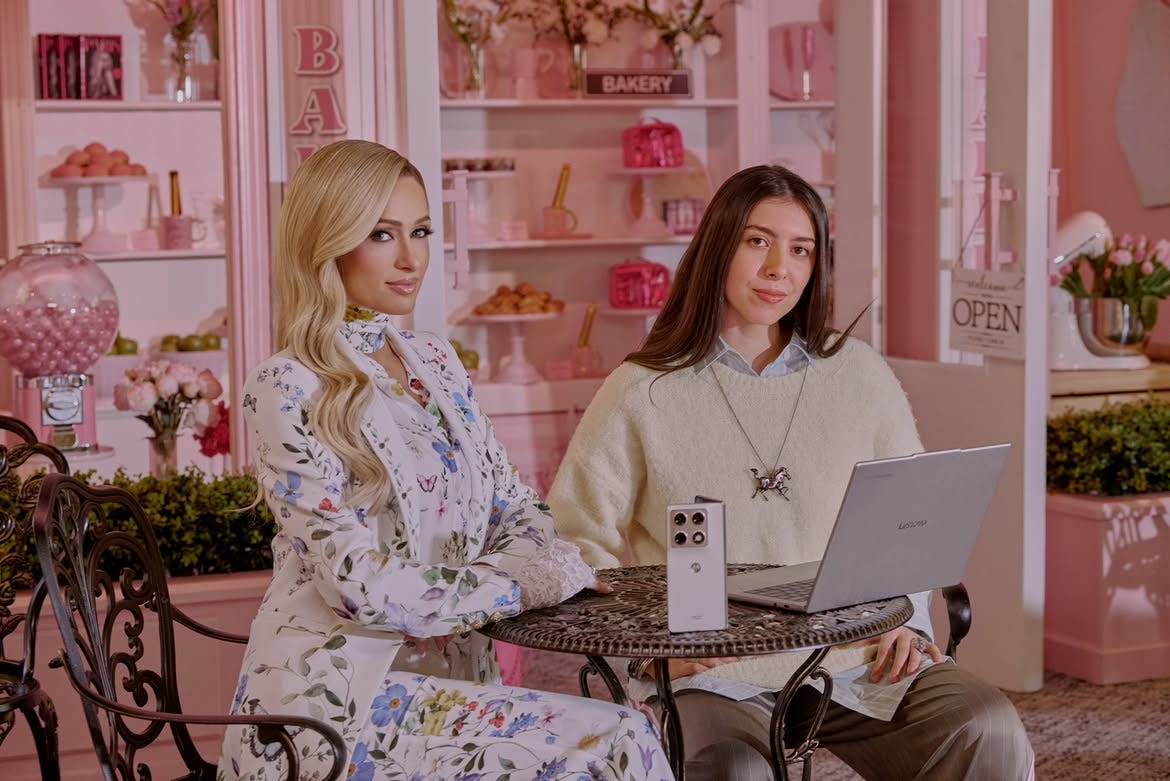
Needless to say, mine isn’t a typical tech job. Last month, we launched a video of me and Paris Hilton using Gemini to build ADHD-friendly apps together. Last quarter, I demoed a live performance tool I built in a weekend to an arena of several thousand and millions more watching online.
My colleagues have made a film with Darren Aronofsky, launched award-winning language learning experiments, and designed the visual language for Genie, Google DeepMind’s first world model.
The work is singular. The people somehow manage to be even more so.
Creative Technology-ing
And yet, no one grows up knowing what a creative technologist is, much less planning to become one.
In high school, I was the number one competitive debater in the country for a stretch. I genuinely thought I was going to be the next Hillary Clinton. I went to Wellesley (her alma mater), where my first job was at a women’s prison and my first major was poli sci.


When I eventually got to comp sci, it didn’t come naturally the way other things had. I was used to coasting to an A on the strength of some combination of charm and genuine interest.
Studying computer science made me actually study, sob, and then study some more. I graduated early at 20, moved to New York, and spent too much time in clubs and not enough time on LinkedIn. My first internship was at a hedge fund in Tokyo4. It was the kind of job that looks excellent on paper but feels, in practice, like wearing someone else’s shoes for three months. A psychic literally pulled me off the street to tell me I was in the wrong career. I’m sure she was saying that to all 20-something white girls clearly appropriating an evil eye necklace, but I was the 20-something white girl it really applied to.


The turning point was when my viral, short-lived TikTok career (don’t ask5) led me to Jeffery Alan Scudder, a well-established net artist, who offered to teach me JavaScript and work out of his studio in Greenpoint. At the time I was subsisting largely on Too Good To Go and momentum6, and broke enough to walk the 45 minutes to his studio rather than take the train. We were building mini-toys for his project, aesthetic.computer, a collaborative web-based art platform. It was my first time playing with hand-tracking, Bitforms7, AI, and nearly every other obsession that would come to structure my life.


On the side, I was doing odd social media marketing jobs, always finishing early, always asking if I could try something more creative tech-y with whatever time was left. I started pitching ideas cold, calling companies until someone said yes. The first one came from a transgirl compression underwear brand that wanted a try-on filter to demonstrate how their product safely concealed their customers’ genitalia. Literally no one had heard of the brand, not even my trans friends. I got paid almost nothing. The filter was borderline impossible to build and delivered half-broken8. Nevertheless, I was insufferably giddy for weeks after they said yes.
‘Creative technologist’ is on its way to becoming less of a mutant profession you have to explain, more of a way of relating to the most pervasive medium on earth.


Around the same time, the clubbing led me to cold-DMing Jackson Walker Lewis the day before he and Shanny Wise started the band FCUKERS. I ended up developing software to live-code their visuals for their debut show at Baby’s All Right with my friend Maria Galebach. With my new javascript skills, I opened the show with videos of porn superimposed onto the band members’ mouths. One project turned into ten: a Pianos residency, a New Museum residency, visuals for club nights, installations for fashion shows, gallery work, app launches, live performances, my own runway shows, and so much more. If the best post-grad advice is to get your feet wet, I was standing in water up to my neck and smiling.
After years of creative technology-ing at bars, museums, theaters, dragshows, and anything in between, I had finally acquired the term I had spent so long accidentally orbiting: Creative Technologist. People still ask, I still explain, and the title still sounds entirely made up.
Someone in Demand
It might only exist in obscurity for a little while longer, though.


If you have any engineering background, you’re used to shrugging off the unsolicited app pitches from Uber drivers, Tinder dates, and distant uncles. But now, when someone tells me their idea, I increasingly find myself thinking: okay — you go make it.
Today, kids are building entire worlds in Roblox like it’s a normal extension of playing. People are making little tools for their friends, their classrooms, or their own weird niche problems. No one waits for permission or funding or someone to translate their idea into code. Coding just feels like… a thing people do now.


And it’s the “doing” that’s being celebrated. When I started, the last thing I expected was to become someone in demand. I did not anticipate creative technologists being pulled into the center of the machine: product teams at Google, design systems at Apple, experimental storytelling at A24. My fellow CTs are being flown out to give talks, poached mid-job with huge pay bumps, and inundated with DMs from startups begging them to find a use for their product (the stories I could tell…).
Tarighian’s work on display at Google Cloud Next 2026.
It all means that “creative technologist” is on its way to becoming less of a mutant profession you have to explain, more of a way of relating to the most pervasive medium on earth.
It took me a remarkably convoluted series of wrong turns to figure out that technology wasn’t just an industry I could work in, but a medium I could think with. I’d be thrilled if the next person didn’t need a finance internship, a street psychic, a TikTok career, and several hundred dollars worth of nightclub cover charges to figure it out.


FAANG is an acronym still sometimes used for the big tech companies (specifically Facebook, Apple, Amazon, Netflix and Google) … even though those giants have changed.
MSCHF, Publicis Groupe, Wieden+Kennedy, Penegram, etc.
Explicitly, at least…
It was actually an investment advisory to hedge funds, but like all my jobs, apparently, that is a mouthful to explain.
Really… don’t.
I was broke, but don’t feel too bad for me. I’m also really cheap.
THE net art gallery, and it’s in nyc!
Pre-chatGPT launching, so…
 | A guest post by
|
Loved reading about your journey in creative tech! I'm a product manager for a MarTech product where my end-users are Creative Technologists that found themselves in the same space later in their careers, so super interesting to hear your perspective of diving in post grad. Killing it!
Creative technology for the win!